import numpy as np
from numpy import log, exp, pi, real
from scipy.integrate import quad
from scipy.stats import norm
from scipy.optimize import brentq, minimize
import matplotlib.pyplot as plt
import pandas as pdCalibrating the Heston Model
Introduction
The Heston Model notebook derives the closed-form option pricing formula from the stochastic volatility dynamics and the characteristic function of the log stock price. This notebook focuses entirely on implementation and calibration: we translate that formula into Python, and then find the model parameters that best match observed call prices on Apple (AAPL) as of October 1, 2024.
Calibration means solving an inverse problem. Given a set of observed option prices C^{\text{obs}}(K_i, T_j) across strikes K_1, \ldots, K_m and maturities T_1, \ldots, T_n, we set v_0 from the short-dated ATM implied volatility and search for the parameter vector (\kappa, \theta, \sigma, \rho) that minimizes the root mean-squared pricing error \text{RMSE} = \sqrt{\frac{1}{mn} \sum_{i=1}^{m} \sum_{j=1}^{n} \left(C^{\text{obs}}(K_i, T_j) - C^{\text{model}}(K_i, T_j)\right)^2}. Once calibrated, the model can be used to price exotic derivatives, compute sensitivities, or simulate risk scenarios with a volatility structure that is consistent with the market.
This notebook presents the simplest possible calibration exercise: we fit all parameters to a single cross-section of option prices on one date. A more rigorous approach would split the data into an estimation sample and a hold-out sample, calibrate (\kappa, \theta, \sigma, \rho) on the training set, and then backtest the model by repricing the hold-out contracts with those fixed parameters. Using the short-dated ATM implied volatility as a proxy for \sqrt{v_0} is a natural choice in any such exercise, because v_0 is the only parameter that should be updated daily as market conditions change, while the structural parameters (\kappa, \theta, \sigma, \rho) are more stable and can be estimated over a longer horizon.
One-factor stochastic volatility models like Heston face inherent limitations in fitting the full surface simultaneously across strikes and maturities. Multifactor extensions that allow the variance process to have richer dynamics can substantially improve the fit, as shown in Cortazar et al. (2017) in the context of commodity markets.
Cortazar, Gonzalo, Matias Lopez, and Lorenzo Naranjo. 2017. “A Multifactor Stochastic Volatility Model of Commodity Prices.” Energy Economics 67: 182–201.
Implementing the Pricing Formula
The Heston call price is C = S e^{-q T} P_1 - K e^{-r T} P_2, where P_2 is the risk-neutral probability of expiring in the money and P_1 is the corresponding probability under the stock-numeraire measure. Both are recovered by Fourier inversion of the joint characteristic function of x(T) = \ln S(T) and v(T).
We begin by loading the required libraries.
The characteristic function
The joint characteristic function of x(T) and v(T) is \begin{gathered} f(\phi, \varphi) = \exp\Bigg(i (r - q) \phi T + \left(\delta - \frac{2 \gamma}{\sigma^{2}}\right) \kappa \theta^{*} T + i \phi x + \delta v \\ \qquad - \frac{2 \kappa \theta^{*}}{\sigma^{2}} \ln\!\left(e^{-\gamma T} - \frac{\sigma^{2}}{2 \gamma} (1 - e^{-\gamma T}) (i \varphi - \delta)\right) \\ \qquad + \frac{v (i \varphi - \delta)}{e^{- \gamma T} - \frac{\sigma^{2}}{2 \gamma} (1 - e^{- \gamma T}) (i \varphi - \delta)}\Bigg), \end{gathered} where \begin{aligned} \gamma &= \sqrt{\kappa^{2} + (1 - \rho^{2}) \sigma^{2} \phi^{2} + i (\sigma - 2 \kappa \rho) \sigma \phi}, \\ \delta &= \frac{\kappa + \gamma - i \rho \sigma \phi}{\sigma^{2}}. \end{aligned} The implementation puts every factor inside the exponential to avoid numerical instabilities from branch cuts in the complex square root.
def CF_Heston(phi1, phi2, S0, V0, T, r, q, kappa, theta, sigma, rho):
    gamma = (kappa**2 + (1 - rho**2) * sigma**2 * phi1**2
             + 1j * (sigma - 2 * kappa * rho) * sigma * phi1)**0.5
    delta = (kappa + gamma - 1j * rho * sigma * phi1) / sigma**2

    y = exp(
        1j * (r - q) * phi1 * T
        + (delta - 2 * gamma / sigma**2) * kappa * theta * T
        + 1j * phi1 * log(S0)
        + delta * V0
        + (-2 * kappa * theta / sigma**2)
        * np.log(exp(-gamma * T) - sigma**2 / (2 * gamma)
                 * (1 - exp(-gamma * T)) * (1j * phi2 - delta))
        + V0 * (1j * phi2 - delta)
        / (exp(-gamma * T) - sigma**2 / (2 * gamma)
           * (1 - exp(-gamma * T)) * (1j * phi2 - delta))
    )
    return y
In-the-money probabilities
The risk-neutral probability P_2 that the call expires in the money is recovered by Fourier inversion of f(\phi, 0).
def P2(S0, V0, K, T, r, q, kappa, theta, sigma, rho):
    integrand = lambda phi1: real(
        exp(-1j * phi1 * log(K))
        * CF_Heston(phi1, 0, S0, V0, T, r, q, kappa, theta, sigma, rho)
        / (1j * phi1)
    )
    y = 0.5 + 1 / pi * quad(integrand, 0, np.inf, full_output=1)[0]
    return y
The probability P_1 under the stock-numeraire measure is obtained by evaluating the characteristic function at \phi - i instead of \phi, then dividing by the forward price F = S e^{(r-q)T}.
def P1(S0, V0, K, T, r, q, kappa, theta, sigma, rho):
    F = S0 * exp((r - q) * T)
    integrand = lambda phi1: real(
        exp(-1j * phi1 * log(K))
        * CF_Heston(phi1 - 1j, 0, S0, V0, T, r, q, kappa, theta, sigma, rho)
        / (1j * phi1)
    )
    y = 0.5 + 1 / pi / F * quad(integrand, 0, np.inf, full_output=1)[0]
    return y
Call price
The European call price follows directly from the two probabilities.
def heston_call_price(S0, V0, K, T, r, q, kappa, theta, sigma, rho):
    call = (S0 * exp(-q * T) * P1(S0, V0, K, T, r, q, kappa, theta, sigma, rho)
            - K * exp(-r * T) * P2(S0, V0, K, T, r, q, kappa, theta, sigma, rho))
    return call
Black-Scholes implied volatility
We also need the Black-Scholes call price and its numerical inversion, both for computing the initial variance v_0 before calibration and for plotting the implied volatility surface afterward.
def bs_call(S, K, T, r, q, sigma):
    d1 = (log(S / K) + (r - q + 0.5 * sigma**2) * T) / (sigma * T**0.5)
    d2 = d1 - sigma * T**0.5
    return S * exp(-q * T) * norm.cdf(d1) - K * exp(-r * T) * norm.cdf(d2)

def bs_implied_vol(S, K, T, r, q, market_price):
    try:
        return brentq(lambda sig: bs_call(S, K, T, r, q, sig) - market_price,
                      1e-6, 5.0)
    except ValueError:
        return np.nan
Verification
We verify the implementation with a standard set of parameter values before moving to real data.
S0_test  = 100
K_test   = 100
T_test   = 1.0
r_test   = 0.05
q_test   = 0.02
kappa_t  = 2.0
theta_t  = 0.04
sigma_t  = 0.5
rho_t    = -0.7
V0_test  = 0.04

call_test = heston_call_price(S0_test, V0_test, K_test, T_test,
                               r_test, q_test, kappa_t, theta_t, sigma_t, rho_t)
print(f"Analytical call price: {call_test:.4f}")
Analytical call price: 8.7526We cross-check the analytical price against a Monte Carlo estimate obtained by simulating the Heston dynamics under the risk-neutral measure. The stock price and variance follow \begin{aligned} dS &= (r - q)\, S\, dt + \sqrt{v}\, S\, dW_1, \\ dv &= \kappa(\theta - v)\, dt + \sigma\sqrt{v}\, dW_2, \end{aligned} where dW_1\, dW_2 = \rho\, dt. We discretize with n equal time steps using the Euler–Maruyama scheme, reflect negative variance to zero at each step, and estimate the call price as the discounted average payoff e^{-rT} \mathbb{E}[\max(S(T)-K,0)].
def heston_mc_call(S0, V0, K, T, r, q, kappa, theta, sigma, rho,
                   n_paths=200_000, n_steps=200, seed=42):
    rng = np.random.default_rng(seed)
    dt = T / n_steps
    sqrt_dt = dt**0.5

    S = np.full(n_paths, float(S0))
    v = np.full(n_paths, float(V0))

    for _ in range(n_steps):
        Z1 = rng.standard_normal(n_paths)
        Z2 = rng.standard_normal(n_paths)
        W1 = Z1
        W2 = rho * Z1 + (1 - rho**2)**0.5 * Z2

        v_pos = np.maximum(v, 0.0)
        sv    = v_pos**0.5

        S = S * np.exp((r - q - 0.5 * v_pos) * dt + sv * sqrt_dt * W1)
        v = v + kappa * (theta - v_pos) * dt + sigma * sv * sqrt_dt * W2

    payoff = np.maximum(S - K, 0.0)
    price  = np.exp(-r * T) * payoff.mean()
    se     = np.exp(-r * T) * payoff.std() / n_paths**0.5
    return price, se

mc_price, mc_se = heston_mc_call(S0_test, V0_test, K_test, T_test,
                                  r_test, q_test, kappa_t, theta_t, sigma_t, rho_t)
print(f"Analytical call price: {call_test:.4f}")
print(f"Monte Carlo estimate:  {mc_price:.4f}  (±{2*mc_se:.4f} at 95%)")
print(f"Difference:            {abs(call_test - mc_price):.4f}")
Analytical call price: 8.7526
Monte Carlo estimate: 8.7832 (±0.0456 at 95%)
Difference: 0.0306The Monte Carlo estimate should be within two standard errors of the analytical price, confirming that the characteristic-function formula and the SDE discretization are consistent.
AAPL Option Data
The option prices used here come from the OptionMetrics (OPTIONM) database. OPTIONM records the highest closing bid and lowest closing ask across all exchanges for every listed contract. We use the midpoint \frac{\text{bid} + \text{ask}}{2} as the market price for each contract. The midpoint is the standard choice in empirical options research because it is free from the direction of trading and minimizes the impact of the bid-ask bounce on estimated parameters.
AAPL options are American-style. For call options with a small dividend yield the early-exercise premium is negligible, so we treat the observed prices as European call prices without adjustment. On October 1, 2024, AAPL closed at $226.21. We use a dividend yield of 0.5% per year and a continuously compounded risk-free rate of 5%.
S0 = 226.21
r  = 0.05
q  = 0.005
We select seven strikes spanning roughly \pm 15% around the current stock price and six standard expiries ranging from 45 days to 198 days, giving 42 contracts in total. Time-to-maturity is measured in years from October 1, 2024.
strikes = [200, 210, 220, 230, 240, 250, 260]

# Expiration dates and exact days to expiry from 2024-10-01
# Nov 15 2024:  45 days; Dec 20 2024:  80 days; Jan 17 2025: 108 days;
# Feb 21 2025: 143 days; Mar 21 2025: 171 days; Apr 17 2025: 198 days
maturities = [45/365, 80/365, 108/365, 143/365, 171/365, 198/365]
maturity_labels = ['Nov-24', 'Dec-24', 'Jan-25', 'Feb-25', 'Mar-25', 'Apr-25']
The midpoint prices below are taken directly from OPTIONM for the contracts described above.
# Midpoint prices: rows = strikes (200 to 260), columns = maturities (Nov-24 to Apr-25)
market_prices = np.array([
    [28.950, 30.775, 32.125, 33.925, 35.325, 36.475],  # K = 200
    [20.450, 22.625, 24.175, 26.300, 27.725, 29.025],  # K = 210
    [13.050, 15.475, 17.075, 19.475, 21.000, 22.400],  # K = 220
    [ 7.275,  9.625, 11.250, 13.725, 15.225, 16.625],  # K = 230
    [ 3.400,  5.350,  6.800,  9.075, 10.525, 11.850],  # K = 240
    [ 1.395,  2.680,  3.750,  5.700,  6.975,  8.175],  # K = 250
    [ 0.540,  1.260,  1.970,  3.425,  4.450,  5.450],  # K = 260
])
We display the data as a table before calibrating.
df_market = pd.DataFrame(
    market_prices,
    index=pd.Index(strikes, name='Strike'),
    columns=maturity_labels,
)
df_market| Nov-24 | Dec-24 | Jan-25 | Feb-25 | Mar-25 | Apr-25 | |
|---|---|---|---|---|---|---|
| Strike | ||||||
| 200 | 28.950 | 30.775 | 32.125 | 33.925 | 35.325 | 36.475 |
| 210 | 20.450 | 22.625 | 24.175 | 26.300 | 27.725 | 29.025 |
| 220 | 13.050 | 15.475 | 17.075 | 19.475 | 21.000 | 22.400 |
| 230 | 7.275 | 9.625 | 11.250 | 13.725 | 15.225 | 16.625 |
| 240 | 3.400 | 5.350 | 6.800 | 9.075 | 10.525 | 11.850 |
| 250 | 1.395 | 2.680 | 3.750 | 5.700 | 6.975 | 8.175 |
| 260 | 0.540 | 1.260 | 1.970 | 3.425 | 4.450 | 5.450 |
Calibration
We calibrate four Heston parameters (\kappa, \theta, \sigma, \rho) by minimizing the RMSE between observed and model call prices, holding v_0 fixed at a value extracted directly from market data.
Fixing the initial variance
Treating v_0 as a free parameter creates a degeneracy: a very large \kappa paired with a v_0 far from the short-term implied variance can produce nearly the same option prices as a moderate \kappa with a well-anchored v_0, because the two parameters compensate each other. Fixing v_0 breaks this degeneracy, reduces the problem from five to four free parameters, and anchors the short end of the volatility surface to a directly observable market quantity.
We set v_0 equal to the squared Black-Scholes implied volatility of the shortest-maturity contract whose strike is nearest to the forward price F = S e^{(r-q)T}.
T_short = maturities[0]
F_short = S0 * exp((r - q) * T_short)
atm_idx = int(np.argmin(np.abs(np.array(strikes) - F_short)))
iv_atm  = bs_implied_vol(S0, strikes[atm_idx], T_short, r, q, market_prices[atm_idx, 0])
V0_fixed = iv_atm**2

print(f"ATM strike (Nov-24): {strikes[atm_idx]}")
print(f"ATM implied vol:     {iv_atm:.4f}  ({iv_atm*100:.2f}%)")
print(f"V0 fixed to:         {V0_fixed:.6f}")
ATM strike (Nov-24): 230
ATM implied vol: 0.2662 (26.62%)
V0 fixed to: 0.070862Running the optimizer
The objective function loops over all 42 contracts using the fixed v_0.
def rmse_heston(params):
    kappa, theta, sigma, rho = params
    total = 0.0
    for i, K in enumerate(strikes):
        for j, T in enumerate(maturities):
            model = heston_call_price(S0, V0_fixed, K, T, r, q, kappa, theta, sigma, rho)
            total += (market_prices[i, j] - model) ** 2
    return np.sqrt(total / (len(strikes) * len(maturities)))
bounds = [
(0.001, 20.0), # kappa
(0.001, 1.0), # theta
(0.001, 5.0), # sigma
(-1.0, 1.0), # rho
]
x0 = [2.0, V0_fixed, 0.5, -0.7]
result = minimize(rmse_heston, x0, method='L-BFGS-B', bounds=bounds)
kappa_cal, theta_cal, sigma_cal, rho_cal = result.x
print(f"kappa = {kappa_cal:.4f}")
print(f"theta = {theta_cal:.4f} (sqrt: {theta_cal**0.5:.4f})")
print(f"sigma = {sigma_cal:.4f}")
print(f"rho = {rho_cal:.4f}")
print(f"V0 = {V0_fixed:.4f} (sqrt: {V0_fixed**0.5:.4f}) [fixed]")
print(f"RMSE = {result.fun:.4f}")kappa = 3.4879
theta = 0.0627 (sqrt: 0.2504)
sigma = 0.8174
rho = -0.4823
V0 = 0.0709 (sqrt: 0.2662) [fixed]
RMSE = 0.2070Interpreting the calibrated parameters
The four calibrated parameters have natural economic interpretations.
The speed of mean reversion \kappa controls how quickly the instantaneous variance returns to its long-run level \theta. Larger values imply faster reversion; as \kappa \to \infty the variance process becomes almost deterministic and the model collapses toward a constant-volatility world.
The long-run variance \theta determines the volatility level that options with long maturities are priced against. Its square root \sqrt{\theta} is directly comparable to the implied volatility of long-dated at-the-money options.
The volatility of volatility \sigma governs the curvature of the implied volatility surface. A larger \sigma produces a more pronounced smile because the variance process itself is more uncertain.
The correlation \rho captures the leverage effect: negative values make price drops and variance increases co-move, which tilts the implied volatility surface into the downward-sloping skew that is characteristic of equity markets. The sign should be negative for AAPL.
Implied Volatility Analysis
We compute the Black-Scholes implied volatility for every contract in the data set.
iv = np.zeros_like(market_prices)
for i, K in enumerate(strikes):
    for j, T in enumerate(maturities):
        iv[i, j] = bs_implied_vol(S0, K, T, r, q, market_prices[i, j])
The figure below shows the implied volatility surface. The axes are strike and days to expiry; the height and color show the level of implied volatility.
from mpl_toolkits.mplot3d import Axes3D

K_grid = np.array(strikes)
T_grid = np.array(maturities) * 365   # days to expiry for the axis label

KK, TT = np.meshgrid(K_grid, T_grid)

fig = plt.figure(figsize=(8, 5))
ax  = fig.add_subplot(111, projection='3d')
surf = ax.plot_surface(KK, TT, iv.T * 100, cmap='inferno', alpha=0.9,
                       linewidth=0.3, edgecolor='0.4')
fig.colorbar(surf, ax=ax, shrink=0.5, aspect=10, pad=0.1, label='IV (%)')
ax.set_xlabel('Strike')
ax.set_ylabel('Days to Expiry')
ax.set_zlabel('Implied Vol (%)')
ax.set_title('AAPL Implied Volatility Surface — October 1, 2024')
plt.tight_layout()
plt.show()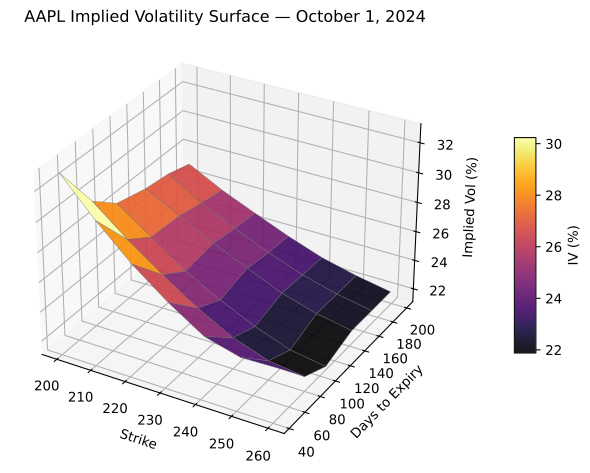
The surface shows the typical equity volatility skew: implied volatilities are highest for low strikes and decrease monotonically as the strike rises. The skew is steeper for short maturities and flattens as maturity increases, which is exactly the pattern produced by the Heston model with a negative \rho.
By construction, \sqrt{v_0} equals the implied volatility of the nearest-ATM Nov-24 option, so the short-dated ATM level is matched exactly. Long-dated options are priced closer to \sqrt{\theta}, reflecting the mean reversion of v toward its long-run level.
Pricing Errors
We compute model prices and pricing errors for all 42 contracts.
model_prices = np.zeros_like(market_prices)
for i, K in enumerate(strikes):
    for j, T in enumerate(maturities):
        model_prices[i, j] = heston_call_price(
            S0, V0_fixed, K, T, r, q, kappa_cal, theta_cal, sigma_cal, rho_cal
        )

abs_errors = np.abs(market_prices - model_prices)
rows = []
for i, K in enumerate(strikes):
for j, (label, T) in enumerate(zip(maturity_labels, maturities)):
rows.append({
'Strike': K,
'Expiry': label,
'Observed': f"{market_prices[i, j]:.3f}",
'Model': f"{model_prices[i, j]:.3f}",
'Abs. Error': f"{abs_errors[i, j]:.3f}",
})
df_errors = pd.DataFrame(rows).set_index(['Strike', 'Expiry'])
df_errors| Observed | Model | Abs. Error | ||
|---|---|---|---|---|
| Strike | Expiry | |||
| 200 | Nov-24 | 28.950 | 28.488 | 0.462 |
| Dec-24 | 30.775 | 30.630 | 0.145 | |
| Jan-25 | 32.125 | 32.191 | 0.066 | |
| Feb-25 | 33.925 | 33.984 | 0.059 | |
| Mar-25 | 35.325 | 35.325 | 0.000 | |
| Apr-25 | 36.475 | 36.557 | 0.082 | |
| 210 | Nov-24 | 20.450 | 19.908 | 0.542 |
| Dec-24 | 22.625 | 22.515 | 0.110 | |
| Jan-25 | 24.175 | 24.300 | 0.125 | |
| Feb-25 | 26.300 | 26.302 | 0.002 | |
| Mar-25 | 27.725 | 27.780 | 0.055 | |
| Apr-25 | 29.025 | 29.128 | 0.103 | |
| 220 | Nov-24 | 13.050 | 12.474 | 0.576 |
| Dec-24 | 15.475 | 15.383 | 0.092 | |
| Jan-25 | 17.075 | 17.310 | 0.235 | |
| Feb-25 | 19.475 | 19.448 | 0.027 | |
| Mar-25 | 21.000 | 21.017 | 0.017 | |
| Apr-25 | 22.400 | 22.443 | 0.043 | |
| 230 | Nov-24 | 7.275 | 6.726 | 0.549 |
| Dec-24 | 9.625 | 9.579 | 0.046 | |
| Jan-25 | 11.250 | 11.490 | 0.240 | |
| Feb-25 | 13.725 | 13.628 | 0.097 | |
| Mar-25 | 15.225 | 15.207 | 0.018 | |
| Apr-25 | 16.625 | 16.648 | 0.023 | |
| 240 | Nov-24 | 3.400 | 3.022 | 0.378 |
| Dec-24 | 5.350 | 5.368 | 0.018 | |
| Jan-25 | 6.800 | 7.052 | 0.252 | |
| Feb-25 | 9.075 | 9.009 | 0.066 | |
| Mar-25 | 10.525 | 10.488 | 0.037 | |
| Apr-25 | 11.850 | 11.859 | 0.009 | |
| 250 | Nov-24 | 1.395 | 1.146 | 0.249 |
| Dec-24 | 2.680 | 2.731 | 0.051 | |
| Jan-25 | 3.750 | 4.024 | 0.274 | |
| Feb-25 | 5.700 | 5.633 | 0.067 | |
| Mar-25 | 6.975 | 6.906 | 0.069 | |
| Apr-25 | 8.175 | 8.119 | 0.056 | |
| 260 | Nov-24 | 0.540 | 0.387 | 0.153 |
| Dec-24 | 1.260 | 1.301 | 0.041 | |
| Jan-25 | 1.970 | 2.179 | 0.209 | |
| Feb-25 | 3.425 | 3.372 | 0.053 | |
| Mar-25 | 4.450 | 4.377 | 0.073 | |
| Apr-25 | 5.450 | 5.372 | 0.078 |
We summarize the mean absolute error for each strike-expiry combination, with marginal averages by row and column.
df_mae = pd.DataFrame(
    abs_errors.round(4),
    index=pd.Index(strikes, name='Strike'),
    columns=maturity_labels,
)
df_mae['Avg'] = abs_errors.mean(axis=1).round(4)
df_mae.loc['Avg'] = abs_errors.mean(axis=0).tolist() + [abs_errors.mean().round(4)]
df_mae| Nov-24 | Dec-24 | Jan-25 | Feb-25 | Mar-25 | Apr-25 | Avg | |
|---|---|---|---|---|---|---|---|
| Strike | |||||||
| 200 | 0.462100 | 0.144600 | 0.065800 | 0.059200 | 0.000200 | 0.081700 | 0.1356 |
| 210 | 0.541500 | 0.110100 | 0.124700 | 0.002400 | 0.054900 | 0.102700 | 0.1560 |
| 220 | 0.575800 | 0.091700 | 0.234900 | 0.026900 | 0.016500 | 0.042600 | 0.1647 |
| 230 | 0.549100 | 0.045900 | 0.239500 | 0.096700 | 0.018000 | 0.022800 | 0.1620 |
| 240 | 0.377700 | 0.017700 | 0.252000 | 0.066500 | 0.036900 | 0.008500 | 0.1265 |
| 250 | 0.248900 | 0.051000 | 0.274300 | 0.067100 | 0.068900 | 0.056000 | 0.1277 |
| 260 | 0.152600 | 0.041400 | 0.209100 | 0.052800 | 0.073400 | 0.077500 | 0.1011 |
| Avg | 0.415384 | 0.071775 | 0.200037 | 0.053076 | 0.038411 | 0.055978 | 0.1391 |
The figure below plots the pricing errors by strike for each expiry.
pricing_errors = model_prices - market_prices

fig, axes = plt.subplots(2, 3, figsize=(9, 5), sharey=True)
for j, (label, ax) in enumerate(zip(maturity_labels, axes.flat)):
    ax.bar(strikes, pricing_errors[:, j], color=['#d62728' if e > 0 else '#1f77b4'
                                                  for e in pricing_errors[:, j]])
    ax.axhline(0, color='0.3', lw=0.8, ls='--')
    ax.set_title(label, fontsize=10)
    ax.set_xticks(strikes)
    ax.set_xticklabels(strikes, fontsize=7)
    ax.spines[['top', 'right']].set_visible(False)

fig.supxlabel('Strike', fontsize=9)
fig.supylabel('Error ($)', fontsize=9)
plt.tight_layout()
plt.show()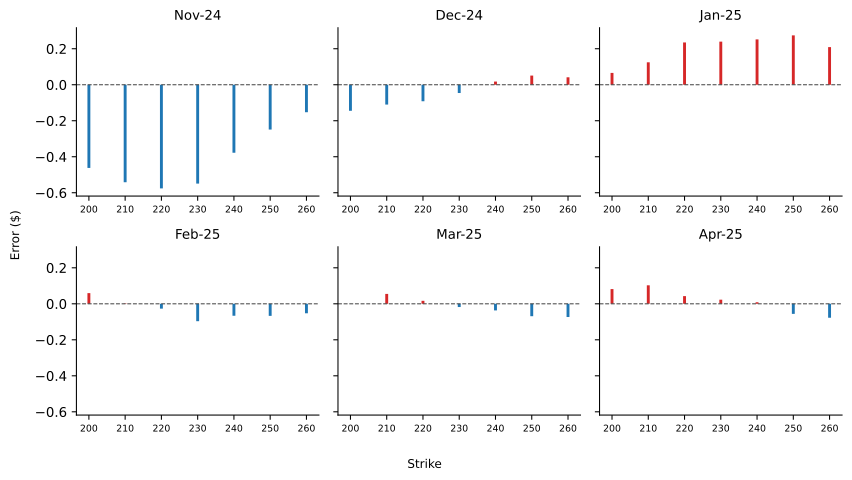
The largest errors occur in short-maturity contracts. This is a structural limitation of the Heston model: the model-implied skew is proportional to \sqrt{T} as maturity shrinks, so it flattens too quickly near expiry and cannot match the steep short-dated skew observed in the market. The RMSE treats all contracts equally, but near-the-money options have larger dollar prices, so their squared errors receive more implicit weight and the optimizer tilts the fit toward those contracts across all maturities.
The overall fit demonstrates that the Heston model can reproduce the main features of the equity implied volatility surface—the level, the skew, and the term structure of volatility—with just four free parameters.