Class 6
Path-Dependent Payoffs
Last session we priced exotic options whose payoff depends only on S_{T} (binary, gap, forward start, and chooser options), so the lognormal distribution of S_{T} and the Black-Scholes formula were enough. The options in this session pay according to the whole history of the price: its maximum S_{\textit{max}}, its minimum S_{\textit{min}}, its average \bar{S}_{T}, or whether it touched a barrier. Pricing still means discounting the expected payoff under the risk-neutral probability, but the expectation now runs over paths. In a tree with n steps of length \Delta t = T / n, q = \frac{e^{(r - \delta) \Delta t} - d}{u - d}, \qquad V = e^{-r T} \sum_{\text{paths}} q^{j} (1 - q)^{n - j} \, X(\text{path}), \tag{1} where j is the number of up moves on the path and X(\text{path}) is the payoff computed along it. The tree for the stock still recombines, but the tree for the option does not: paths ud and du end at the same price with different maxima and averages. There are 2^{n} paths against n + 1 final prices, so with many steps one either keeps track of the extra state variable at each node (the running maximum, or whether the barrier was hit) or simulates risk-neutral paths and averages their discounted payoffs.
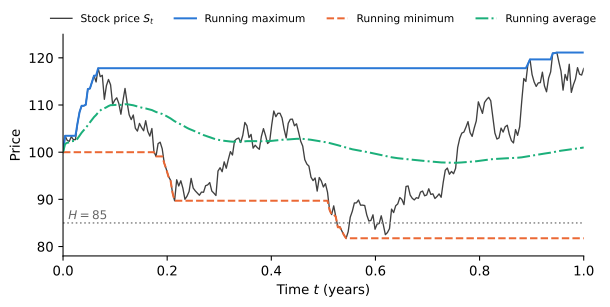
Figure 1 shows one year of a simulated stock price with the running maximum, minimum, and average that the options below use.
Lookback Options
A lookback option replaces either the strike or the final price with the extreme price reached during the life of the option:
| Type | Call | Put |
|---|---|---|
| Floating lookback | S_{T} - S_{\textit{min}} | S_{\textit{max}} - S_{T} |
| Fixed lookback | \max(S_{\textit{max}} - K, 0) | \max(K - S_{\textit{min}}, 0) |
The floating lookback call buys at the lowest price of the period and the put sells at the highest, so both are always exercised. Since S_{\textit{max}} \geq S_{T} \geq S_{\textit{min}} on every path, \max(S_{\textit{max}} - K, 0) \geq \max(S_{T} - K, 0), \qquad \max(K - S_{\textit{min}}, 0) \geq \max(K - S_{T}, 0), \tag{2} and S_{T} - S_{\textit{min}} \geq \max(S_{T} - S_{0}, 0) because S_{\textit{min}} \leq S_{0}. A lookback therefore costs more than the corresponding European option. It is insurance against bad timing, and the buyer pays for it. On the path of Figure 1, the floating lookback call pays 117.75 - 81.75 = 36.00, while an at-the-money European call pays 17.75.
Asian Options
An Asian option uses the average price, defined in continuous time and in a tree with n steps as \bar{S}_{T} = \frac{1}{T} \int_{0}^{T} S_{t} dt, \qquad \bar{S}_{T} = \frac{1}{n + 1} \sum_{i = 0}^{n} S_{i \Delta t}, \tag{3} where the tree average includes the price at t = 0. An average price call pays \max(\bar{S}_{T} - K, 0) and the put pays \max(K - \bar{S}_{T}, 0). An average strike call pays \max(S_{T} - \bar{S}_{T}, 0) and the put pays \max(\bar{S}_{T} - S_{T}, 0).
Averaging smooths the path, so the average is less volatile than the final price, and an average price option is usually cheaper than the European option with the same strike, even though on some paths it pays more. Options on the arithmetic average in (3) have no exact formula: they are priced on trees, by simulation, or by approximating \bar{S}_{T} as lognormal. The contract fits exposures that build up over time, such as a firm that converts foreign revenue into dollars every month and cares about the average exchange rate it gets, and a payoff that depends on many prices is hard to move by trading near expiration. On the path of Figure 1, an at-the-money average price call pays only 100.99 - 100 = 0.99.
Barrier Options
A barrier option is a call or put that comes into existence (in) or dies (out) when the price touches a barrier H, approached from below (up) or from above (down). The two directions, in or out, and call or put give eight contracts. On every path the barrier is either touched or not, so exactly one of an in option and the matching out option is alive at maturity. The in call pays \max(S_{T} - K, 0) \mathbf{1}_{\{\text{hit}\}}, the out call pays \max(S_{T} - K, 0) \mathbf{1}_{\{\text{not hit}\}}, and \mathbf{1}_{\{\text{hit}\}} + \mathbf{1}_{\{\text{not hit}\}} = 1 \qquad \Longrightarrow \qquad C_{\textit{in}} + C_{\textit{out}} = C, \tag{4} and the same holds for puts. In-out parity means we only need to price one of the pair. A barrier option is cheaper than the European option because it gives up the payoff on some paths, which is what makes it attractive: a buyer who needs protection only in a crash, or who considers some paths unlikely, does not pay for them. On the path of Figure 1, a down-and-in call with K = 100 and H = 85 is activated and pays 17.75, while the down-and-out call dies at t \approx 0.53 and pays nothing.
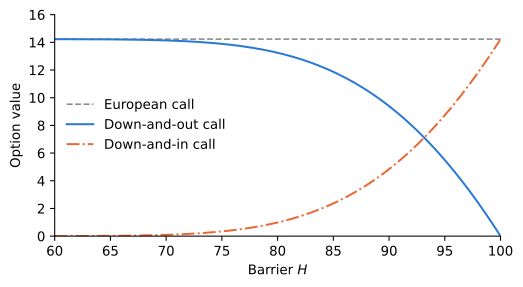
Figure 2 shows how the barrier moves value between the two calls. A barrier far below the stock price is rarely touched, so the down-and-out call is almost a European call. As H approaches S, the barrier is touched almost surely and the value shifts to the down-and-in call. Two practical points matter. First, the contract specifies when the barrier is checked, usually at the daily close, and a tree only checks it at its nodes, so a coarse tree misses crossings between dates and overprices out options. Second, an up-and-out call with H > K is hard to hedge: just below the barrier it is deep in the money, yet it is worthless once S touches H, so its delta \Delta becomes large and negative near the barrier.
Other Exotic Options
Compound options are options on options: a call on a call, a put on a call, a call on a put, or a put on a put. A call on a call with strike K_{c} and exercise date \tau, written on a call with strike K and maturity T > \tau, pays \max(C_{\tau} - K_{c}, 0) at \tau, where C_{\tau} is the value of the underlying call then. In a tree we price the underlying call first and then the compound option on the values C_{\tau}. Since equity is a call on the assets of a levered firm, an option on its stock is a compound option.
Exchange options give the right to exchange one asset U for another asset V, paying \max(V_{T} - U_{T}, 0). Measuring prices in units of U turns the payoff into U_{T} \max(V_{T} / U_{T} - 1, 0), a call on the ratio V / U with strike 1. The interest rate drops out because the holder pays with U, not cash, and the relevant volatility is that of V / U, which depends on the correlation of the two assets: assets that move together have a stable ratio and make a cheap exchange option. A basket option is a call or put on a portfolio of assets, usually priced by matching the first two moments of the basket value to a lognormal.
Shout options let the buyer shout once, at a time \tau of their choice, to lock in the intrinsic value then. A shout call pays \max(S_{T} - K, S_{\tau} - K) = (S_{\tau} - K) + \max(S_{T} - S_{\tau}, 0), \tag{5} the gain locked in at the shout plus a fresh at-the-money call from \tau to T. After the shout, the option is worth (S_{\tau} - K) e^{-r (T - \tau)} plus a Black-Scholes call with strike S_{\tau}. It is a cheaper relative of the floating lookback, since the buyer tries to shout near the maximum but may miss it.
Non-standard American options restrict early exercise to specific dates (Bermudan options), allow it only after a lock-out period, or change the strike over the life of the contract, as in some warrants and convertibles. On a tree, the early exercise check is simply made only at the allowed nodes.
Practice Problems
A stock that pays no dividends trades for $50. Every six months its price rises by 20% or falls by 10%. The risk-free rate is 5% per year with continuous compounding. All options below expire in one year, and averages include the price at t = 0.
- Compute the risk-neutral probability q, and list the four paths with their minimum, maximum, and average prices.
- Price a floating lookback call that pays S_{T} - S_{\textit{min}}.
- Price a fixed lookback put with K = 50 and a European put with K = 50. Explain the difference using the payoffs.
- Price an average price call with K = 50 and a European call with K = 50. On which path does the average price call pay more? Why is it still cheaper?
A stock that pays no dividends trades for $100. Every four months its price rises or falls by 10%, and the risk-free rate is 6% per year with continuous compounding. Consider one-year calls with strike K = 100 and an up barrier H = 120, checked at the nodes of the tree.
- List the eight paths, and mark those on which the stock reaches $120 or more.
- Price the up-and-out call and the up-and-in call directly from the paths.
- Price the European call with K = 100 on the recombining tree, and verify in-out parity.
- The up-and-out call is much cheaper than the European call. Who would buy it, and what does the buyer give up?
A shout call on a stock that pays no dividends has strike K = 100. The stock volatility is 25% and the risk-free rate is 4% per year with continuous compounding. With six months left, the stock trades at $115 and the holder shouts.
- Use (5) to write the payoff at maturity as a function of S_{T}.
- Compute the value of the option right after the shout.
- Compare it with the value of a European call with K = 100 and six months to maturity, and explain the difference using the payoffs.
- Explain why a floating lookback call is worth more than a shout call.
A stock trades for $100, and all options below have one year to maturity: a European call with K = 100, a fixed lookback call with K = 100, a floating lookback call, an average price call with K = 100, and a down-and-out and a down-and-in call with K = 100 and H = 80.
- Which pairs of these options can be ranked by comparing their payoffs path by path? Rank them.
- Describe a path on which the average price call pays more than the European call, and explain why the average price call is nevertheless cheaper.
- With the parameters of Figure 2, the European call is worth $14.23 and the down-and-in call is worth $0.99. What is the down-and-out call worth? Why is it so close to the European call?
- What happens to both barrier calls as H rises toward $100?
A stock that pays no dividends trades for $40. Every three months its price rises by 15% or falls by 10%, and the risk-free rate is 6% per year with continuous compounding. A European call with K = 40 expires in six months. A compound call gives the right, in three months, to buy this call for K_{c} = \$2.
- Price the European call at each node of the tree.
- Price the compound call today.
- Find the replicating portfolio for the compound call today: N_{S} shares and N_{Z} zero-coupon bonds paying $1 in three months.
- A buyer who exercises the compound call pays its price today plus $2 in three months. Why might the buyer prefer this to buying the European call today?